Impossible Landscapes (Detwiller 2021) details several historical intrusions by the King in Yellow prior to the campaign’s inciting events. In a section titled “The King in History,” this series of events begins in 1402 with Augustus Chastaigne’s inheritance of the Château des Portes and ends with Operation INDIA MOON in 2015.
Situated along this timeline, I want to provide some evidence that suggests another intrusion from the King, one that is parallel but somewhat disconnected from the events in the Hotel Broadalbin (1911-1936), and that shows itself most clearly in the work of Gertrude Stein.
Gertrude Stein (1874-1946) was an American author and poet. Her most well-known works include the poetry collection Tender Buttons (1914) and the epic-length The Making of Americans (1925). She is most closely associated with the Modernist tradition and generally considered a pioneer for various avant-garde movements afterwards. Some of her most famous quotations include “Rose is a rose is a rose” from the poem Sacred Emily, and “there is no there there,” from The Autobiography of Alice B. Toklas (1933).
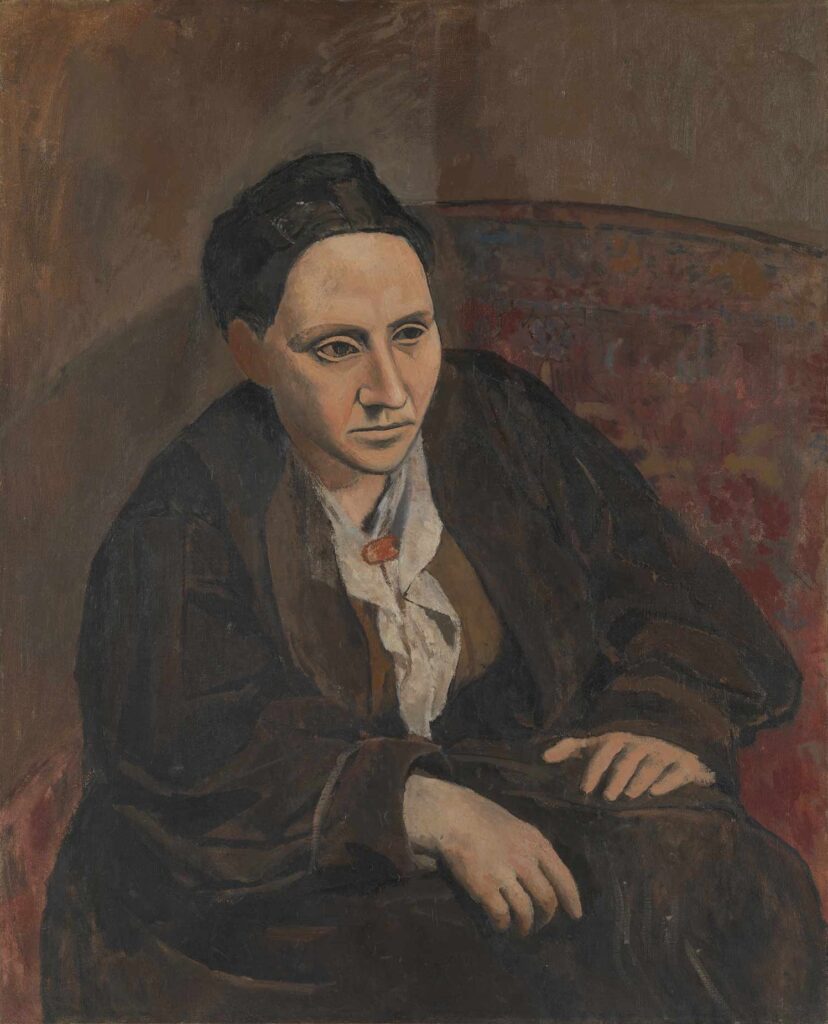
An early portrait
The exact date and means by which Stein made contact with The King in Yellow is unclear. Stein moved to 27 rue de Fleurus in 1903, some 8 years after the performance of Le Roi en jaune and in Paris in 1895.
Speculation suggests that early contact with the KIY would have been just as if not more probably through art than literature. Stein’s famous Saturday evening salons put her in contact with a wide range of avant-garde writers and artists. In addition to visits by famous figures such Pablo Picasso, Ernest Hemingway, and Henri Matisse, this would have been an excellent opportunity for the distribution of illicit and/or occult works. Although there is no evidence to suggest that Stein ever saw or read The Yellow Book, it seems probable that she was in contact with those who had.
One early incident bears mention. When beginning work on his portrait of Stein in 1905, Picasso reportedly struggled with Stein’s face. Leaving it until the end, he repeatedly erased and restarted it, unsatisfied with the results. As described by Isabelle Duvernois, “It is tempting to think that Picasso, consciously or not, had fallen under the spell of her idiosyncratic, modulated repetition and kept repainting her face and hands, repeatedly shifting them, ever so slightly.”1 Later repainting from memory alone, Picasso’s rendition became more and more mask-like, with harsh geometric features. The exact origins of the mask-like renditions are unclear. Some trace Picasso’s interest to Iberian sculpture, whereas others connect them more to Catalan Romanesque art. However, as argued by Robert Lubar,2 the more important question is rather the function of the mask itself. How does one paint a face that is itself as mask?
When asked about the painting, Picasso infamously claimed that “everybody says that she does not look like it but that does not make any difference, she will.”3 Had he truly seen her, not as she was, but as she would become? Within those sessions, did Picasso impart some deeper knowledge of the King to Stein? Or had Stein already come into contact with the King’s influence far earlier, and was this latent and indescribable force against which he was struggling?
Yet another possibility, barely beyond speculation, is that Stein’s acquaintance with the occult was born not initially of art or poetry, but that she was introduced to the KIY by Alice B. Toklas. One passage from Autobiography recounts Alice’s purchase of a notable hat shortly after moving to Paris: “I had bought my first winter Paris hat. It was a very fine hat of black velvet, a big hat with a brilliant yellow fantaisie.”
Tender buttons
Like a dormant virus, the influence of the KIY is harder to identify in earlier works. In early passages, yellow is described as dirty mixture:
A single image is not splendor. Dirty is yellow. A sign of more in not mentioned. A piece of coffee is not a detainer. The resemblance to yellow is dirtier and distincter. The clean mixture is whiter and not coal color, never more coal color than altogether.
Tender Buttons, “Objects”
In this sense, as in “Cranberries,” yellow is not so much seen as is smelled: “Cut the whole space into twenty-four spaces and / then and then is there a yellow color, there is but it is / smelled, it is then put where it is and nothing stolen.”
From a passage in “Rooms,” one is tempted to read into the association between yellow the the king: “The change is mercenary that settles whitening the coloring and serving dishes where there is metal and maKING yellow any yellow every color in a shade which is expressed in a tray” (73, my emphasis). But this is surely a bit of a stretch. There are, as one would expect, no mentions of Carcosa, the Yellow Sign, or even the 1895 play.
American psychology
One thing that is certain, both in this early stage and later on, is that Stein was not mad. Madness was not the word. Rather, as becomes most clear in The Making of Americans, Stein’s work was driven by an incessant and unforgiving rationality. In her description of Julia Dehning, Stein writes: “She never ever really stopped her sad trickling, to her joy was as it has been said of laughing, it is madness … I often think if I could be so fixed as never to laugh or to smile I should be one step better, it fills me with sorrow when I see people so full of laugh.”4 If laughter is madness, then Stein prefers a kind of exuberant intensity, a kind of serious play or playful seriousness.
There are many being living. There are many family livings being existing. There are many being one being living. There are many being one being in family living. Any one of them will do and there are many of them, any one of them will do for being one being existing, for being one being in a family living. Any one of them will do as every one of them is existing, as any one of them is in a family living.
The Making of Americans
In developing a history of Americans, Stein exhaustively works through possibilities: “I am hoping sometime to be right about every one, about everything. I do.” Concrete details slowly build into higher and higher levels of abstraction, as beings and identities overlap in their existence.
The final sentence: “Any family living can be one being existing and some can remember something of some such thing.” One almost has the image of a final chorus, of millions of voices echoing across worlds, but this is wrong. It is more like the last step of a logical proof.
Are we wrong to think of the King’s influence as one that develops in madness? If anything, what Stein’s case suggests is that the madness itself is a kind of caricature, one the serves more as a shielding mythology surrounding Delta Green’s operations than as a true recounting of those who come into contact.
The plays
Stein’s first play, What Happened: A Play, was written in 1913, but was not performed until 1950. More recently, it was preformed in 2019 at the Hotel de Lauzun in Paris.5 On the surface, it seems to recount a dinner party that Stein attended that was hosted by the painter Harry Gibb. But rather than depicting a series of events and characters, the play functions more like a dungeon. As described by Rebekka Jolley, the play creates a textual geography, one that is “a large multi-dimensional area that the audience and reader can explore while navigating various planes of meaning.”6 Act one involves a tiger in an overcoat, a vegetable window, and a “real shooting” somehow connected to a Christmas shutter. In act two, we learn that (fortunately) nobody is wounded. Act three concerns the metaphysical distinction between a cut and a slice: “The reason that a cut is a slice is that if there is no hurry any time is just as useful.”7 Act four involves a birthday speech and a blanket. Finally, in act five, we see a single doorway, one that becomes equated with a photograph, which is itself a “sight of something.”
Stein’s most explicit suggestions about contact with the KIY occur in the play THE KING OR SOMETHING (THE PUBLIC IS INVITED TO DANCE), written in 1917, and published in Geography and Plays in 1922. To date, there is no record I have been able to find of its performance. The play is divided not into acts, but pages, often spanning no more than a line. Page II, for example, reads only: “I hear a noise.” While difficult to map explicitly, the play very much suggests the imagery of Carcosa: a lake, with reference to the hotel Alcazar, a land of surrounding cities, where birds fly in the sky amongst automobiles, and changing places.
Finally, in the three-act play White Wines (likely written in 1913), composed mostly of prose paragraphs, contains a further clue. Seemingly out of nowhere, after a discussion on the nature of change, we read: “…and the king is the king and the king is the king and the king is the king” (GP 214). Written the same year as Stein’s infamous line “Rose is a rose is a rose,” it is impossible to know which was first. One can only imagine it possible, however, that the King was its true meaning, a yellow crown hidden beneath the redness of reality.
- “A Face is a Face is a Face.” https://www.metmuseum.org/essays/picasso-gertrude-stein ↩︎
- Lubar, Robert S.. “Unmasking Pablo’s Gertrude: Queer Desire and the Subject of Portraiture.” The Art Bulletin (1997). ↩︎
- The Autobiography of Alice B. Toklas, chapter 2. https://gutenberg.net.au/ebooks06/0608711h.html ↩︎
- The Making of Americans. https://gutenberg.net.au/ebooks16/1600671h.html ↩︎
- Audio available here. Listener discretion advised. https://radiofreestein.com/plays/what-happened/ ↩︎
- Jolley, Rebekka. “What happened in Gertrude Stein’s Collaged Narrative.” 2021. https://www.royalholloway.ac.uk/media/18548/9-what%20happened.pdf.pdf ↩︎
- Geography and Plays. https://www.gutenberg.org/files/33403/33403-h/33403-h.htm ↩︎